
About Department
 The Department of Computer Science and Engineering was established in 2007 with a sanctioned intake of 60 to offer B.Tech course and was subsequently enhanced to 480 intake in the academic year of 2025-2026. In its pursuit of the mission, the department invests its efforts continuously in identifying the additional skills empowering programs that not only enhance the employability of the students but also equip them to successfully pursue their career path. A well-balanced team of faculty that is a right mix of experience and energetic youth facilitates the right academic environment needed for academic excellence in the overall development of the learner.
Salient Features
- Regular academics of basic technical and technological skills blended with the judicious combinations of additional and value added multi-dimensional skills programs that enhance
- Self-help skills like personality development.
- Social skills like communication and behavioral skills.
- Ethical skills like adherence to well-mannered conduct in a group.
- These additional but necessary skills are expected to help students evolve into engineers who are highly motivated with practical, creative, and management skills that would go a long way in scripting their careers as both employees as well as employers.
- Faculty team comprises people with proven track record in their own domains of engineering education covering such diverse areas as Artificial Intelligence, Machine learning, Web technologies, and Data Analytics, in addition to the ever expanding core areas of Computer Networks, Operating Systems, Computer Organization, Database Management systems, Algorithms Design etc., well balanced by the programming skills of different paradigms that are essential for the Computer Science Engineers.
- Well equipped necessary infrastructural facilities in terms of hardware, licensed software, and network including Internet connectivity with open access to all through its dedicated Internet center to cater to the needs of the students and faculty alike.
- Plan Schedule and Conduct add-on courses and programs that are helpful for the student to pursue their career.
- Highly proactive department in its responsibility for the Industry-Institution- Interaction by organizing expert lectures at regular intervals with the experienced and expert practitioners from the industry.
- Established innovation and research centers like Microsoft Innovation Centre (MIC), Big Data Centre of Excellence and Cloud Computing Centre and Center for Artificial Intelligence and Machine Learning.
- Established Student Chapter of Computer Society of India.
- Institutional member of Computer Society of India.
- Learner friendly environment where the students are encouraged to participate in technical seminars, annual events organized both in the college as well as outside.
- Our students have brought laurels to both the department and college by winning prizes at national level contests.






Accreditation


HOD Profile

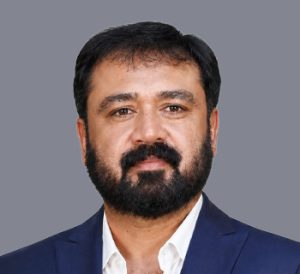
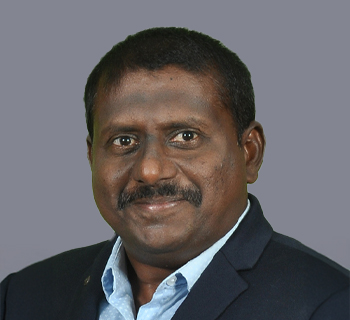
Dr. Ch. Vijaya Kumar
Professor & Head for 2nd, 3rd & 4th Year CSE
Dr. Ch. Vijaya Kumar is a dedicated academician with over two decades of teaching and research experience in the field of Computer Science and Engineering. Throughout his career, he has played a vital role in shaping both undergraduate and postgraduate education, with expertise in diverse areas such as Machine Learning, Artificial Intelligence, Big Data, Cyber Security, and Computer Networks.
His contributions go far beyond classroom teaching. Dr.Vijay Kumar has been actively engaged in research and innovation, publishing papers in reputed SCOPUS and SCIE-indexed journals, securing patents in emerging domains, and authoring a textbook on Machine Learning. His research particularly focuses on developing efficient solutions in Big Data and Streaming Data Processing, bridging the gap between theoretical advancements and their real-world applications.
As a CISCO-certified instructor and Chairman Board of Studies CSE, he has contributed to curriculum development and faculty training, ensuring that academic programs align with industry needs. His leadership as Head of the CSE Department at ACE Engineering College is marked by initiatives that encourage innovation, including organizing hackathons, coding contests, technical fests, and faculty development programs.
In recognition of his contributions, Dr. Vijay Kumar received the Best Instructor Award from CISCO Networking Academy (2025), along with several academic and professional accolades for his excellence in teaching, research, and leadership.
Dr. Vijay Kumar’s academic journey is a reflection of his commitment to excellence in teaching, passion for impactful research, and dedication to nurturing the next generation of engineers. His ability to combine deep subject expertise with practical insights continues to inspire students, peers, and the academic community.

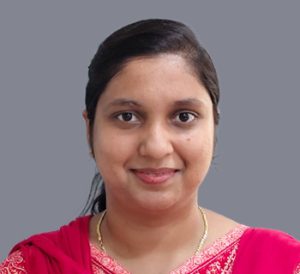
Dr. Srisudha Garugu
Associate Professor & Head for First Year CSE
Dr. Srisudha Garugu is an accomplished academician and researcher in Computer Science and Engineering with over 17 years of teaching and research experience. She has served as Assistant Professor in reputed engineering colleges and as a full-time Ph.D. Research Scholar at Andhra University, teaching a wide range of subjects including Programming, Artificial Intelligence, Data Science, Internet of Things, and Quantum Computing. Her research contributions span Natural Language Processing, Machine Learning, Deep Learning, and Quantum Computing applications, with numerous publications in Scopus, IEEE, Springer, and UGC-approved journals, a book chapter with IGI Global, and filed patents.
She has actively participated in NPTEL certifications, AICTE-ATAL FDPs, workshops, and national conferences, and is frequently invited as a resource person and guest lecturer. Beyond teaching and research, she contributes to institutional development as Alumni Coordinator and Newsletter Coordinator at ACE Engineering College, and has played a key role in NBA Accreditation, ISO recognition, and AICTE documentation. Her strong academic foundation, diverse teaching portfolio, and impactful research make her a dedicated contributor to both student success and institutional growth.
.
Vision and Mission

Vision of the Department
To be an Epicenter of excellence in education by offering Thrust courses, research and services for the students and make them to succeed in professional competitive examinations globally with an attitude of Entrepreneurial skills, ethical values and social concern.
Mission of the Department
Imparting quality Technical Education to young Computer Engineer by providing them
- M1: Impart quality technical Education with State of-the-art laboratories, Analytical and Technical Skills with International standards by qualified and experienced faculty.
- M2: Prepare for competitive examinations for higher studies / Employment.
- M3: Develop professional attitude, Research aptitude, Critical Reasoning and technical consultancy by providing training in cutting edge technologies.
- M4: Endorse and Nurture knowledge, Life-long learning, Entrepreneurial practices, ethical values and social concern.
Program Educational Objectives (PEOs)
PEO 1:To prepare the students for successful careers in Computer Science and Engineering and fulfill the need by providing training to excel in competitive examinations for higher education and employment.
PEO 2: To provide students a broad-based curriculum with a firm foundation in Computer Science and Engineering, Applied Mathematics & Sciences. To impart high quality technical skills for designing, modeling, analyzing and critical problem solving with global competence.
PEO 3: To inculcate professional, social, ethical, effective communication skills and entrepreneurial practice among their holistic growth.
PEO 4: To provide Computer Science and Engineering students with an academic environment and members associated with student related to professional bodies for multi-disciplinary approach and for lifelong learning.
PEO 5: To develop research aptitude among the students in order to carry out research in cutting edge technologies, solve real world problems and provide technical consultancy services.
Knowledge and Attitude Profile (WK)
WK1: A systematic, theory-based understanding of the natural sciences applicable to the discipline and awareness of relevant social sciences.
WK2: Conceptually-based mathematics, numerical analysis, data analysis, statistics and formal aspects of computer and information science to support detailed analysis and modelling applicable to the discipline.
WK3: A systematic, theory-based formulation of engineering fundamentals required in the engineering discipline.
WK4: Engineering specialist knowledge that provides theoretical frameworks and bodies of knowledge for the accepted practice areas in the engineering discipline; much is at the forefront of the discipline.
WK5: Knowledge, including efficient resource use, environmental impacts, whole-life cost, reuse of resources, net zero carbon, and similar concepts, that supports engineering design and operations in a practice area. WK6: Knowledge of engineering practice (technology) in the practice areas in the engineering discipline.
WK7: Knowledge of the role of engineering in society and identified issues in engineering practice in the discipline, such as the professional responsibility of an engineer to public safety and sustainable development.
WK8: Engagement with selected knowledge in the current research literature of the discipline, awareness of the power of critical thinking and creative approaches to evaluate emerging issues.
WK9: Ethics, inclusive behavior and conduct. Knowledge of professional ethics, responsibilities, and norms of engineering practice. Awareness of the need for diversity by reason of ethnicity, gender, age, physical ability etc. with mutual understanding and respect, and of inclusive attitudes.
Program Outcomes (POs)
PO1: Engineering Knowledge: Apply knowledge of mathematics, natural science, computing, engineering fundamentals and an engineering specialization as specified in WK1 to WK4 respectively to develop to the solution of complex engineering problems.
PO2: Problem Analysis: Identify, formulate, review research literature and analyze complex engineering problems reaching substantiated conclusions with consideration for sustainable development. (WK1 to WK4)
PO3: Design/Development of Solutions: Design creative solutions for complex engineering problems and design/develop systems/components/processes to meet identified needs with consideration for the public health and safety, whole-life cost, net zero carbon, culture, society and environment as required. (WK5)
PO4: Conduct Investigations of Complex Problems: Conduct investigations of complex engineering problems using research-based knowledge including design of experiments, modelling, analysis & interpretation of data to provide valid conclusions. (WK8)
PO5: Engineering Tool Usage: Create, select and apply appropriate techniques, resources and modern engineering & IT tools, including prediction and modelling recognizing their limitations to solve complex engineering problems. (WK2 and WK6)
PO6: The Engineer and The World: Analyze and evaluate societal and environmental aspects while solving complex engineering problems for its impact on sustainability with reference to economy, health, safety, legal framework, culture and environment. (WK1, WK5, and WK7)
PO7: Ethics: Apply ethical principles and commit to professional ethics, human values, diversity and inclusion; adhere to national & international laws. (WK9)
PO8: Individual and Collaborative Team work: Function effectively as an individual, and as a member or leader in diverse/multi-disciplinary teams.
PO9: Communication: Communicate effectively and inclusively within the engineering community and society at large, such as being able to comprehend and write effective reports and design documentation, make effective presentations considering cultural, language, and learning differences
PO10: Project Management and Finance: Apply knowledge and understanding of engineering management principles and economic decision-making and apply these to one’s own work, as a member and leader in a team, and to manage projects and in multidisciplinary environments.
PO11: Life-Long Learning: Recognize the need for, and have the preparation and ability for i) independent and life-long learning ii) adaptability to new and emerging technologies and iii) critical thinking in the broadest context of technological change. (WK8)
Program Specific Outcomes (PSOs)
PSO1: To prepare the students ready for industry usage by providing required training in cutting edge technologies.
PSO2: An Ability to use the core concepts of Computing and Optimization Techniques to develop more efficient and effective computing mechanisms.
PSO3: Prepare the graduates to Demonstrate a sense of Societal and Ethical Responsibility in their Professional Endeavors and will remain informed and involved as full participants in the profession and our society.
Faculty
| Name of the Programme | CSE | |
|---|---|---|
| Approved Intake (2025) | 480 (Approved by Gov’t of Telangana) | |
| No. of Faculty Members | 71 | |
|
Cadre |
Number |
|
| Professor | 04 | |
| Assoc. Professor | 17 | |
| Asst. Professor | 50 | |
| Faculty Profile |
Qualification |
No. of Faculty |
| Ph.D | 12 | |
| Ph.D (Pursuing) | 19 | |
| Post Graduate | 40 | |
| Technical Staff | Programmers | 05 |


















Research and Development
Faculty Research Publications
Faculty Research Publications
Academic Year: 2025-26
| S.No. | Name of the Author | Title of the Paper | Journal / Conference Name | ISSN / ISBN | Vol / Issue | DOI / Paper Link | Published Month & Year |
|---|---|---|---|---|---|---|---|
| 1 | Dr. Ch. Vijaya Kumar | A COMPUTER VISION-BASED THYROID DISEASE PREDICTION USING AN EBOLA OPTIMIZATION ENHANCED DEEP LEARNING MODEL | Journal of Theoretical and Applied Information Technology | ISSN: 1992-8645 E-ISSN: 1817-3195 |
Vol.104 No.8 | Link | 30th April 2026 |
| 2 | Dr. T V Sai Krishna | HYBRID MACHINE LEARNING MODELS FOR INTEGRATED URBAN AIR QUALITY AND WEATHER FORECASTING | Journal of Theoretical and Applied Information Technology | ISSN: 1992-8645 E-ISSN: 1817-3195 |
Vol.104 No.2 | Link | January 2026 |
| 3 | Mr. B. Narsimhulu | Enhancing Energy Efficiency in Edge-Cloud Systems through Deep Reinforcement Learning-Based Task Scheduling | 2025 2nd International Conference on Recent Trends in Electrical, Electronics and Computing Technologies (ICRTEECT) | – | Pages 1-6 | DOI:10.1109/ ICRTEECT67512.2025. 11448767 |
26 March 2026 |
| 4 | Dr. Khaleel Ur Rahman Khan | Lightweight Frequency-Aware Super-Resolution for Real-Time Satellite Image Enhancement | 2025 IEEE International Conference on Next-Gen Technologies of Artificial Intelligence and Geoscience Remote Sensing (EarthSense) | eISBN: 979-8-3315-0288-1 | Pages 1-6 | Link | September 2025 |
| 5 | Dr. Ch. Vijaya Kumar | DeepSign Vox: A Vision-Driven CNN Framework for Real-Time Hand Gesture Recognition and Text-to-Speech Conversion | Advances in Consumer Research Journal (Scopus Indexed) | ISSN: 0098-9258 | Volume-2 Issue-6 | https://acr-journal.com | December 2025 |
| 6 | Dr. T V Sai Krishna | DeepSign Vox: A Vision-Driven CNN Framework for Real-Time Hand Gesture Recognition and Text-to-Speech Conversion | Advances in Consumer Research Journal (Scopus Indexed) | ISSN: 0098-9258 | Volume-2 Issue-6 | https://acr-journal.com | December 2025 |
| 7 | Mrs. Talekar Rohini | Enhancing Stroke Risk Prediction with Stochastic Boosting and Adaptive Grid-based Modeling | Proceedings of ICEARS 2025 IEEE Xplore | ISBN: 979-8-3315-0967-5 | pp.365-370 | DOI:10.1109/ ICEARS64219.2025. 10940256 |
December 30, 2025 |
| 8 | Mrs. Dhomala Aswani | Ensemble Learning-Based Mental Analysis and Prediction of Mental Disorder | 2025 International Conference on Sustainability, Innovation & Technology (ICSIT), IEEE | 979-8-3315-3549-0/25 | – | DOI:10.1109/ ICSIT65336.2025. 11293926 |
December 20, 2025 |
| 9 | Dr. Sri Sudha Garugu | Artificial Intelligence in Bioanalytical Chemistry: A Review of Algorithms, Applications, and Future Prospects | Journal of Applied Bioanalysis (Scopus Indexed) | ISSN: 2405-710X | Vol.11 No.4 | http://doi.org/10.53555/ jab.v11i4.410 |
August 2025 |
| 10 | Dr. S. Raghu | Segmentation of Blood Vessels Using PCA and CNN | International Journal of Maritime Engineering (SCI Indexed) | – | Vol.167 No.A2(S) | Link | August 2025 |
| 11 | Dr. T. V. Sai Krishna | Improving Software Fault Prediction With a Hybrid DE-WOA Optimizer and ANFIS-Enhanced Ensemble Learning | IEEE Access (SCI Indexed) | – | – | DOI:10.1109/ ACCESS.2025. 3603980 |
29 August 2025 |
| 12 | Mr. A. Ramesh | Detection and Risk Prediction of Brain Tumor using Model-Agnostic Explainable Artificial Intelligence | ICCSCE 2025 Proceedings | ISBN: 978-94-6463-858-5 ISSN: 2352-538X |
– | Link | November 2025 |
| 13 | Dr. Ch. Vijaya Kumar | Early Osteoporosis Prediction Using a Hybrid Deep Learning Method | 3rd International Conference on Algorithms in Advanced Artificial Intelligence (ICAAAI-2025) | Accepted for Publication | Paper ID 210 | Taylor & Francis CRC Press | 11–13 December 2025 |
| 14 | Mr. A. Ramesh | Early Osteoporosis Prediction Using a Hybrid Deep Learning Method | ICAAAI-2025 | Accepted for Publication | Paper ID 210 | Taylor & Francis CRC Press | 11–13 December 2025 |
| 15 | Mr. V. Chandra Sekhar Reddy | Early Osteoporosis Prediction Using a Hybrid Deep Learning Method | ICAAAI-2025 | Accepted for Publication | Paper ID 210 | Taylor & Francis CRC Press | 11–13 December 2025 |
| 16 | Mr. A. Ramesh | Enhancing Lung Cancer Diagnosis Testing Through a Hybrid Approach | ICAAAI-2025 | Accepted for Publication | Paper ID 103 | Taylor & Francis CRC Press | 11–13 December 2025 |
Faculty Research Publications
Academic Year: 2024-25
| S.No. | Name of the Author | Title of the Paper | Journal / Conference Name | ISSN No. | Vol / Issue | DOI / Paper Link | Published Month & Year |
|---|---|---|---|---|---|---|---|
| 1 | Dr. T.V. Sai Krishna | Detection of Foliar Pathogens in Tomato Plant Using Deep Bidirectional Recurrent Neural Networks Optimized with Fennec Fox Optimizer | Zhuzao / Foundry | ISSN: 1001-4977 | Volume 28 Issue 5 | DOI:10.29014/FJ-2025-1001-4977.89.2037 | 2025 |
| 2 | Dr. T.V. Sai Krishna | Improving Software Fault Prediction With a Hybrid DE-WOA Optimizer and ANFIS-Enhanced Ensemble Learning | IEEE Access | SCIE, Web of Science, Scopus Indexed | – | DOI:10.1109/ACCESS.2025.3603980 | August 2025 |
| 3 | Dr. G. Srisudha | Comparative Analysis of Classical and Quantum Algorithms for Solving Linear Systems of Equations | Journal of Theoretical and Applied Information Technology | ISSN: 1992-8645 E-ISSN: 1817-3195 |
Vol. 103, No. 12 | https://www.jatit.org/volumes/Vol103No12/18Vol103No12.pdf | June 2025 |
| 4 | Dr. V. Ravi Kumar | DAIMS: Data Acquisition via Intelligent Mobile Sink in Wireless Sensor Networks | International Journal of Computer Networks and Applications | ISSN: 2395-0455 | Volume 12, Issue 3 | DOI:10.22247/ijcna/2025/27 | June 2025 |
| 5 | Dr. V. Ravi Kumar | Improve Accuracy in Healthcare Data Analysis using Competitive Ensemble Deep Learning Model | IEEE Xplore – INDIACom 2024 | 978-93-80544-51-9 | pp. 1792-1797 | DOI:10.23919/INDIACom61295.2024.10498390 | 2024 |
| 6 | Dr. M.V. Vijaya Saradhi | A Machine Learning based Cyber Attack Detection Model for Wireless Sensor Networks in Microgrids | IJRASET | ISSN: 2321-9653 | Volume 13, Issue VI | DOI:10.22214/ijraset.2025.72191 | June 2025 |
| 7 | Dr. Khaleel Ur Rahman Khan | Improving Digital Forensic Security: A Secure Storage Model With Authentication And Optimal Key Encryption | IJARSCT | ISSN: 2581-9429 | Impact Factor: 7.67 | DOI:10.48175/IJARSCT-28047 | June 2025 |
| 8 | Mr. A. Ramesh | Intelligent Classroom Monitoring System for Enhanced Learning Environments Using Deep Learning | IJSREM | ISSN: 2582-3930 | Impact Factor: 8.586 | DOI:10.55041/IJSREM50260 | June 2025 |
| 9 | Dr. Ch. Vijaya Kumar | Machine Learning for Real-Time Fuel Consumption Prediction and Driving Profile Classification | IJARSCT | ISSN: 2581-9429 | Impact Factor: 7.67 | DOI:10.48175/IJARSCT-28053 | June 2025 |
| 10 | V. Chandra Sekhar Reddy | Smart sentry cyber threat intelligence in industrial IoT | IJARSCT | ISSN: 2581-9429 | Impact Factor: 7.67 | DOI:10.48175/IJARSCT-27436 | June 2025 |
| 11 | Dr. V Ravi Kumar | Enhancing Victim Detection in Disaster Scenarios – A YOLOv7 and YOLOv8 performance study | IJARSCT | ISSN: 2581-9429 | Impact Factor: 7.67 | DOI:10.48175/IJARSCT-27960 | June 2025 |
| 12 | Ms. Shubhangi Mahule | Advanced Product Helpfulness Detection using BERT and LSTM | IJSREM | ISSN: 2582-3930 | Impact Factor: 8.586 | DOI:10.55041/IJSREM50318 | June 2025 |
| 13 | Mrs. P. Swaroopa | Implementing a Blockchain-Based Secure File Storage System with Enhanced User Authentication | IJSREM | ISSN: 2582-3930 | Impact Factor: 8.586 | DOI:10.55041/IJSREM50622 | June 2025 |
| 14 | Mrs. D. Aswani | Financial Fraud Detection Using Explainable AI and Federated Learning | IJRASET | ISSN: 2321-9653 | Impact Factor: 8.067 | https://doi.org/10.22214/ijraset.2025.71922 | June 2025 |
| 15 | Dr. T. V. Sai Krishna | E-VOTING SYSTEM USING ETHEREUM BLOCKCHAIN TECHNOLOGY | IJRASET | ISSN: 2321-9653 | Volume 13 Issue V | DOI:10.22214/IJRASET.2025.71860 | June 2025 |
| 16 | Dr. Ch. Vijaya Kumar | Intelligent policing system harnessing llms for smarter law enforcement | IJESAT | ISSN: 2250-3676 | Volume 25, Issue 06 | https://ijesat.com/ijesat/files/V25I601_1749451795.pdf | June 2025 |
| 17 | Dr. M.V. Vijaya Saradhi | Design and Development of Brain Tumor Classification using Hybrid Deep Learning Algorithm | IJTSRD | 2456-6470 | Volume 9 Issue 1 | https://www.ijtsrd.com/papers/ijtsrd75030.pdf | Jan-Feb 2025 |
| 18 | Dr. V. Ravi Kumar | Facial Recognition Smart Attendance System | IRJMETS | 2582-5208 | Volume 07 / Issue 02 | https://www.doi.org/10.56726/IRJMETS67277 | Feb 2025 |
| 19 | Mr. Aga Parvej | Intrusion Detection System For Enhanced Network Security | IRJMETS | 2582-5208 | Volume 07 / Issue 01 | https://doi.org/10.56726/IRJMETS66934 | Jan 2025 |
| 20 | Mrs. P. Swaroopa | Multilingual Video Summarization using NLP and Machine Learning | ISJEM | 2583-6129 | Volume 04 Issue 01 | https://isjem.com/volume04issue01january2025/ | Jan-Feb 2025 |
Academic Year: 2023-24
International Conference Papers
| Sl. No. | Name of the Faculty | Title of the Research Paper | Journal/Conference Name & Details | Publisher | Month & Year |
|---|---|---|---|---|---|
| 1 | Dr. V. Ravi Kumar | Deep learning-based brain tumor detection: an MRI segmentation approach | MATEC Web of Conferences 392, 01157 (2024) ICMED 2024 | Scopus Indexed | March 2024 |
| 2 | Dr. Khaleel Ur Rahman Khan | An optimized crypto-based routing protocol for secure routing in wireless sensor networks | Wiley Concurrency and Computation Practice and Experience | Wiley – Scopus Indexed | March 2024 |
| 3 | Dr. M.V. Vijaya Saradhi J Varshini Fahmida Ashraf Rithvik K M Namratha |
Decentralized Task Offloading with Block Chain Technology in Vehicular Networks | International Conference on Innovations, Challenges and Solutions in Engineering Science and Technology-2024 (ICICSET) | ICICSET Proceedings | May 2024 |
| 4 | Mr. D Krishna V Rohit Vempati Chekri Vanam Pavan U Harshitha T Pooja |
Employee Salary Prediction Using Machine Learning | ICICSET organized by Sri Indu College of Engineering & Technology, Hyderabad | ICICSET Proceedings | May 2024 |
| 5 | Mr. D Krishna M Prasanna Praveen Kumar Shreya Manisha Ashwini |
Water Potability | ICICSET organized by Sri Indu College of Engineering & Technology, Hyderabad | ICICSET Proceedings | May 2024 |
| 6 | Mr. V. Veeresh A Shreshna U Rahul Raj M Devi Sree G Swapna |
Early Detection of Parkinson’s Disease Using Machine Learning | ICICSET organized by Sri Indu College of Engineering & Technology, Hyderabad | ICICSET Proceedings | May 2024 |
| 7 | Mrs. P. Swaroopa S Sai Varsha G Sathvika R Sandhya S Sree Lakshmi |
Multimodal Biometric Authentication System (Iris, Face, Fingerprint) with Voice | ICICSET organized by Sri Indu College of Engineering & Technology, Hyderabad | ICICSET Proceedings | May 2024 |
| 8 | Mrs. D. Aswani | Cloud Enabled Authentication and Public Key Supervision Service | ICICSET organized by Sri Indu College of Engineering & Technology, Hyderabad | ICICSET Proceedings | May 2024 |
| 9 | Dr. M.V. Vijaya Saradhi | Identifying Tremor Disease in Neurological Disorders using Finger Gesture Images | DST SERB Sponsored International Conference on Algorithms in Advanced Artificial Intelligence (ICAAAI-2023) | Taylor & Francis – Scopus Indexed | December 2023 |
| 10 | Mr. A. Ramesh | Deep Learning Approach for early Detection and Diagnosis of Teenager Interstitial Lung Disease | DST SERB Sponsored International Conference on Algorithms in Advanced Artificial Intelligence (ICAAAI-2023) | Taylor & Francis – Scopus Indexed | December 2023 |
National Conference Papers
| Sl. No. | Name of the Faculty | Title of the Research Paper | Journal/Conference Name & Details | Month & Year |
|---|---|---|---|---|
| 28 | Dr. M V Vijaya Saradhi | Crop Prediction Using Machine Learning | National Conference on Recent Advancement in Science, Engineering and Technology 2024 (RASET’24) | May 2024 |
| 29 | Dr. M V Vijaya Saradhi | Nex-Gen Cultivation – The evolution of greenhouse | RASET’24 – Saveetha University, Chennai | May 2024 |
| 30 | Dr Ch Vijaya Kumar | AI-Based Student Guidance Chatbot | RASET’24 – Saveetha University, Chennai | May 2024 |
| 31 | Mr V Chandrasekhar Reddy | Detection of Phishing Websites (Chitrachaayan) | RASET’24 – Saveetha University, Chennai | May 2024 |
| 32 | Mr D Krishna | Driver’s Drowsiness Detection Using Machine Learning | RASET’24 – Saveetha University, Chennai | May 2024 |
| 33 | Mr P Srinivasa Rao | Brain Tumor Detection Using Convolution Neural Networks | RASET’24 – Saveetha University, Chennai | May 2024 |
Journal Publications
| Sl. No. | Faculty Name | Title of the Research Paper | Journal Title | ISSN / Impact Factor | Month & Year |
|---|---|---|---|---|---|
| 61 | Mrs. Pethota Swaroopa | A Research Investigation: Exploring Storytelling through AI | International Journal of Progressive Research In Engineering Management And Science (IJPREMS) | e-ISSN: 2583-1062 | IF: 5.725 | April 2024 |
| 62 | Mr. A. Ramesh | Cancer Prediction at Early-Stages using Machine Learning | IJPREMS | e-ISSN: 2583-1062 | IF: 5.725 | April 2024 |
| 63 | Mrs. Y. Durga Bhargavi | Exploring The Implementation Of A Distributed Ledger Approach For Blockchain-Based Integrated Electronic Health Records | IJPREMS | e-ISSN: 2583-1062 | IF: 5.725 | April 2024 |
| 64 | Dr. V. Ravi Kumar | A Comparative Study Of Fake Indian Currency Detection Techniques | IJPREMS | e-ISSN: 2583-1062 | IF: 5.725 | April 2024 |
| 65 | Mr. V. Chandra Sekhar Reddy | A Survey On Blockchain Based Detection System For Unveiling Counterfeit Products | IJPREMS | e-ISSN: 2583-1062 | IF: 5.725 | April 2024 |
| 66 | Mr. A. Ramesh | Refining the Detection of Medicinal Plants Using Machine Learning and Image Analysis Techniques | IJPREMS | e-ISSN: 2583-1062 | IF: 5.725 | April 2024 |
Patents
2025-2026
| Sl. No | Title of the Invention | Name of the Inventor(s) & Applicant(s) | Publication Date | Application No. | Status | Filing Date |
|---|---|---|---|---|---|---|
| 1 | AI-DRIVEN PREDICTIVE FRAMEWORK FOR COVID-19 VACCINE RESPONSE AND POST-VACCINATION HEALTH RISK ASSESSMENT | ANKAM SRUTHI | 2/6/2026 | 202511131865 A | Published | 12/26/2025 |
| 2 | AI, IOT AND CLOUD CONVERGENT FROZEN MEAT INVENTORY MANAGEMENT AND UTILIZATION STRATEGY AND SYSTEMS | 1. Dr. Chandarapu Vijaya Kumar 2. Ramesh Alladi 3. V. Chandra Sekhar Reddy 4. Dr. V. Ravi Kumar 5. Dr. T. V. Sai Krishna 6. Dr. Salla Raghu 7. B. Narsimhulu 8. P. Srinivasa Rao |
02/01/2026 | 202541124638 A | Published | 10/12/2025 |
2024-2025
| Sl. No | Title of the Invention | Name of the Inventor(s) & Applicant(s) | Publication Date | Application No. | Status | Filing Date |
|---|---|---|---|---|---|---|
| 1 | System and Method for Optimized Blockchain Data Storage in Distributed Ledger Networks | Mr. Narsimhulu Bommineni | 14/02/2025 | 202541008640 A | Published | 03/02/2025 |
| 2 | Security Encryption using AES and Visual Cryptography | Ms. Shubhangi Mahule Mrs. E. Uma Rani Dr. M.V. Vijaya Saradhi Mr. A. Ramesh Mr. V. Chandra Sekhar Reddy Mrs. N. Swathi Mrs. P. Swaroopa Mr. V. Veeresh Mrs. P. Mamatha Mr. R. Narender ACE Engineering College |
21/06/2024 | 202441045494 | Published | 12/06/2024 |
2023-2024
| Sl. No | Title of the Invention | Name of the Inventor(s) & Applicant(s) | Publication Date | Application No. | Status | Filing Date |
|---|---|---|---|---|---|---|
| 1 | DATA DRIVEN CRIME ANALYSIS USING OPTIMISED K-MEANS CLUSTERING | Dr. M.V. VIJAYA SARADHI Mr D KRISHNA Mrs T. RATHNAMALA Mrs. Y. DURGA BHARGAVI Mr. T. SIVA LAKSHMAIAH Mrs. ROHINI Mr. NAGA RAJA KUMAR Mr. P. SANTOSH P. SATISH BHASKER Mr. V. VEERESH ACE ENGINEERING COLLEGE |
23-02-2024 | 20244100255 | Published | 12-01-2024 |
| 2 | AI BASED MEDICAL DEVICES FOR COLD STORAGE OF FLUIDS | Mr. RAMESH ALLADI Mr. V. CHANDRA SEKHAR REDDY Mr. CHANDARAPU VIJAYA KUMAR |
02-04-2024 | 381290-001 | Granted | 11-03-2023 |
| 3 | FACE DETECTION AND IDENTIFICATION IN NETWORKED VIDEO SURVEILLANCE SYSTEMS USING ADAPTIVE LEARNING ALGORITHM | Mrs. MAMATHA POREDDY DR. M.V. VIJAYA SARADHI Mrs. ESARAPU UMARANI Mrs. NEELOJU SWATHI Mrs. ROHINI RUSTHUM TALEKAR Mr. RAMESH ALLADI Mr. SAMUDRALA VENUGOPAL Mr. M. SIVA KUMAR |
22-12-2023 | 202341077353 | Published | 14-11-2023 |
| 4 | A COMPUTER-IMPLEMENTED SYSTEM AND METHOD FOR EVALUATING WEBSITES BASED ON USER OPINIONS AND SENTIMENTS | Mrs. PETHOTA SWAROOPA Mrs. PEDDABOINA YAMUNA Mrs. MAMATHA POREDDY Mrs. CH. SRIVATSA ALIVELU MANGATAYI Mrs. T RATNAMALA Mrs. Y DURGA BHARGAVI Mrs. ESARAPU UMARANI Mrs. B. UMARANI Mr. THOTA SIVALAKSHMAIAH Dr. M.V. VIJAYA SARADHI |
27-10-2023 | 202341067014 | Published | 06-10-2023 |
| 5 | A RAINWATER HARVESTING SYSTEM WITH DOWNSPOUT DIVERTER | Mr. CHANDARAPU VIJAYA KUMAR Dr. M.V. VIJAYA SARADHI Mr. RAMESH ALLADI Mrs. ESARAPU UMARANI Mr. V. CHANDRA SEKHAR REDDY Mrs. MAMATHA POREDDY Mrs. CH. SRIVATSA ALIVELU MANGATAYI Mr. P. SRINIVASA RAO Mrs. DHOMALA ASWANI Mrs. T RATNAMALA |
08-09-2023 | 202341058246 | Published | 30-08-2023 |
| 6 | AUTONOMOUS DELIVERY ROBOT AND METHOD THEREOF | Mr. V. CHANDRA SEKHAR REDDY Mr. CHANDARAPU VIJAYA KUMAR Dr. M.V. VIJAYA SARADHI Mr. RAMESH ALLADI Mrs. DHOMALA ASWANI Mrs. PEDDABOINA YAMUNA Mr. P. SRINIVASA RAO Mr. D. KRISHNA Mr. THOTA SIVALAKSHMAIAH Mrs. Y DURGA BHARGAVI |
08-09-2023 | 202341057328 | Published | 26-08-2023 |
| 7 | SECURITY ENCRYPTION USING AES AND VISUAL CRYPTOGRAPHY | Ms. SHUBHANGI MAHULE Mrs. ESARAPU UMARANI Dr. M.V. VIJAYA SARADHI Mr. RAMESH ALLADI Mr. V CHANDRA SEKHAR REDDY Mrs. NEELOJU SWATHI Mrs. PETHOTA SWAROOPA Mr. VADDE VEERESH Mrs. MAMATHA POREDDY Mr. Ramavath Narender ACE ENGINEERING COLLEGE |
21-06-2024 | 202441045494 | Published | 12-06-2024 |
|
Sl. No |
Name of the Faculty |
Title of the Invention |
Publication Date |
Application No. |
Status |
Filing Date |
|
|
Mr.Ch.VijayaKumar |
A Rainwater Harvesting System with Downspout Diverter |
08-09-2023 |
202341058246 |
Published |
30-08 2023 |
|
|
Mr.V.ChandraSekhar Reddy |
Autonomous Delivery Robot and Method Thereof |
08-09-2023 |
202341057328 |
26-08- 2023 |
|
|
|
Dr.M.V.VijayaSaradhi |
Artificial Intelligence and IoT based Automatic rainfall detection and alert system at early stages using rainfall threshold, WSN, Cloud and Machine Learning Algorithms |
30/12/2022 |
202241071994 |
Published |
13/12/2022 |
|
|
Mrs. P.Swaroopa |
Integrating the Internet of Things to Construct a Robust Agricultural Management System |
09/09/2022 |
202241050083A |
Published |
01/09/2022 |
|
|
Dr. M.V. VijayaSaradhi |
IoT, Cloud Computing Based Automatic Bed Tracking System In Hospitals Using Ml Algorithms |
18/02/2022 |
202211007205 |
Published |
10/02/2022 |
|
|
Dr. Khaleel Ur Rahman Khan |
Recognition Of Distributed Denial Of Service Attacks Utilizing Machine Learning And Soft Methods |
11/02/2022 |
202241006229 |
Published |
05/02/2022 |
|
|
Mr. D. Krishna |
A System for genomic information compression by configurable machine learning based arithmetic coding |
11/03/2022 |
202231006793 |
Published |
08/02/2022 |
Books
Academic Year: 2024-25
| Sl. No. | Name of the Faculty | Title of Book | ISBN | Publisher | Year |
|---|---|---|---|---|---|
| 1 | Dr. G. Srisudha | Transforming Language Acquisition: AI-Powered Approaches to English Language Teaching and Learning | ISBN: 979-8-3373-1952-0 | In A. Suresh & G. Pavani (Eds.), IGI Global Chapter 2, pp. 73–92 DOI: 10.4018/979-8-3373-1952-0.ch002 Book Chapter – IGI Global |
2025 |
| 2 | Dr. M.V. Vijaya Saradhi | Cybersecurity Challenges in the Metaverse: An Exploration | 9798337303406 DOI: 10.4018/979-8-3373-0340-6 Ch:016 |
IGI Global, Scientific Publishing, publishing tomorrows research today. | April 2025 |
| 3 | Mr. Aga Parvej | Cybersecurity Challenges in the Metaverse: An Exploration | 9798337303406 DOI: 10.4018/979-8-3373-0340-6 Ch:016 |
IGI Global, Scientific Publishing, publishing tomorrows research today. | April 2025 |
| 4 | Mr. D. Ruthwik Reddy | Cybersecurity Challenges in the Metaverse: An Exploration | 9798337303406 DOI: 10.4018/979-8-3373-0340-6 Ch:016 |
IGI Global, Scientific Publishing, publishing tomorrows research today. | April 2025 |
Books
Academic Year: 2024-25
| Sl. No. | Name of the Faculty | Title of Book | ISBN | Publisher | Year |
|---|---|---|---|---|---|
| 1 | Dr. M.V. Vijaya Saradhi | Mastering Scripting Languages: Ruby, TCL, and Perl Fundamental programs, problem solving and practical applications | ISBN-13 979-8281620833 | Amazon Kindle | April 2025 |
| 2 | Dr. M.V. Vijaya Saradhi Dr. T.V. Sai Krishna Mrs. Ch. Srivatsa Alivelu Mangatayi Mrs. P. Swaroopa |
Understanding AI: The Rise of Explainable Intelligence | ISBN: 978-93-49686-86-1 | Chyren Publication Publication: 1st Edition |
April 2025 |
| 3 | Dr. M.V. Vijaya Saradhi | Beyond Algorithms: Exploring the Human Side of Machine Learning | 978-93-6252-206-1 | IIP Iterative International Publishers | June 2024 |
Book Chapters
Academic Year: 2023-24
| Sl. No. | Name of the Faculty | Title of Book | ISBN / Book Series | Publisher | Year |
|---|---|---|---|---|---|
| 5 | Dr. M.V. Vijaya Saradhi Mrs. Yarrabally Durga Bhargavi |
Enhancing Explainability in AI Driven Healthcare Decision Support Systems: A Domain Specific and Stakeholder centric Approach | Book Series Id: IIPV3EB09_G68 Future Trends in Artificial Intelligence |
IIP Iterative International Publishers, Novi, Michigan, USA Chikkamangluru, Karnataka, India |
2023 |
| 6 | Dr. M.V. Vijaya Saradhi Mr. A. Ramesh Mr. V. Chandra Sekhar Reddy |
Cyber security Law in the Cloud: A survey of Data Protection Practices and Challenges in Cloud Computing | Book Series Id: IIP_V3_2023_BS_21_44 Advances in Cyber Security and Digital Forensics |
IIP Iterative International Publishers, Karnataka | 2023 |
Books
Academic Year: 2023-24
| Sl. No. | Name of the Faculty | Title of Book | ISBN | Publisher | Year |
|---|---|---|---|---|---|
| 4 | Dr. M.V. Vijaya Saradhi Mrs. P. Yamuna |
Quantum Computing Decoded: From Basics to Mastery | ISBN-13: 978-9357477383 ISBN-10: 9357477381 First Edition |
IIP Iterative International Publishers, Karnataka | February 2024 |
| 5 | Dr. M.V. Vijaya Saradhi Mrs. Yarrabally Durga Bhargavi |
Data Driven Creativity Empowering Innovation through Data Science | 978-93-5747-441-2 | IIP Iterative International Publishers, Karnataka | 2023 |
| 6 | Dr. M.V. Vijaya Saradhi | From Text to Insight: A Journey through NLP and Information Retrieval Fusion | 978-93-5747-572-3 | IIP Iterative International Publishers, Karnataka | 2023 |
Book Chapters
Academic Year: 2022-23
| Sl. No. | Name of the Faculty | Title of Book | ISBN | Publisher | Year |
|---|---|---|---|---|---|
| 1 | Dr. Khaleel Ur Rahman Khan | Exploring Reasoning for utilizing the full potential of Semantic Web | Edition 1st Edition, Pages 28 eBook ISBN 9781003309420 |
Imprint CRC Press | 2022 |
| 2 | Mr. K. Prem Kumar | Virtual Machine Consolidation using enhanced crow Search Optimization Algorithm in Cloud Computing Environment | Lecture notes in Electrical Engineering ISBN 978-981-19-2280-0 ISBN 978-981-19-2281-7 (eBook) |
Springer Nature Singapore | 2022 |
Books
Academic Year: 2022-23
| Sl. No. | Name of the Faculty | Title of Book | ISBN | Publisher | Year |
|---|---|---|---|---|---|
| 1 | Mr. Ramesh Alladi Mr. Ch. Vijaya Kumar |
Introduction And Fundamental Concepts Of Machine Learning | ISBN – 978-81-960243-3-8 | Published by: AGPH Books (Academic Guru Publishing House) | 2022 |
Infrastructure
The Department of Computer Science and Engineering consists of
• 26 Classrooms
• 16 Labs
• A Seminar Hall
• A Department Library
• 5 Skill Centers.
Each classroom is well equipped with a
• White Board
• Smart Board
• LCD Projector
The Department of Computer Science and Engineering has an exclusive well-stacked library.
The Library collection consists of
- 951 Text book titles with 9317 Volumes.
- 04 International Journals
- 12 National Journals
- News papers
- E-Journals and e-books

The Department of Computer Science and Engineering has six research centers to encourage the faculty and students towards research in the area of Networks, Cloud Computing, Big Data Analytics, Machine Learning, and Artificial Intelligence.
Skill Centers:
- Microsoft Innovation Center (MIC)
- Big Data Apex Center of Excellence
- Cloud Computing Center of Excellence
- Center for Artificial Intelligence and Machine Learning
- CISCO Network Academy
I YEAR II SEMESTER – PROGRAMMING FOR PROBLEM SOLVING LAB
 The objective of Programming for Problem Solving Lab is to make students work with an IDE to create, edit, compile, run and debug programs. The lab imparts knowledge of C programming fundamentals, Control Flow, Arrays, Functions, Pointers, Files and Structures.
Hardware
- 60 HP Desktop Systems
- 11 KVA UPS
- 7 KVA UPS
Software
- Ubuntu 14.04
- gcc Compiler
- g++ Compiler
List of Experiments
Basic Programs
- Write a simple program that prints the results of all the operators available in C (including pre/ post increment, bitwise and/or/not, etc.). Read required operand values from standard input.
- Write a simple program that converts one given data type to another using auto conversion and casting. Take the values form standard input.
- Write a program to convert temperature from Fahrenheit to Celsius and vise
- A building has 10 floors with a floor height of 3 meters each. A ball is dropped from the top of the building. Find the time taken by the ball to reach each floor. (Use the formula s = ut+(1/2)at^2 where u and a are the initial velocity in m/sec (= 0) and acceleration in m/sec^2 (= 9.8 m/s^2)).
- Write a C program to find simple and compound interest.
- Write a C program to find Gross salary of an Employee.
Decision Making Statements
- Write a program for fiend the max and min from the three numbers.
- Write a C program, which takes two integer operands and one operator from the user, performs the operation and then prints the result. (Consider the operators +,-,*, /, % and use Switch Statement)
- Write program that declares Class awarded for a given percentage of marks, where
mark <40%= Failed, 40% to <60% = Second class, 60% to <70%=First class, >=
70% = Distinction. Read percentage from standard input. - Write a C program to find the roots of a Quadratic equation.
- Write a C program to find grade of a student using else if ladder.
- C program to read weekday number and print weekday name using switch.
Loops
- Write a program that prints a multiplication table for a given number and the number of rows in the table.Example:
5 x 1 = 5
5 x 2 = 10
5 x 3 = 15
- Write a C program to print the following patterns:
1
1 2
1 2 3
*
* *
* * *
1
2 3
4 5 6
1
2 2
3 3 3
4 4 4 4
* * * *
* * *
* *
*
a)
1
2 3
4 5 6
7 8 9
b)
1
01
101
0101
10101
c)
1
22
333
4444
55555
d)
*
***
*****
*******
*********
*******
*****
***
*
- Find the sum of the following series:
- 1² + 2² + 3² + 4² + … + N²
- 1/2 − 2/3 + 3/4 − 4/5 + 5/6 − … n
- 1 − X²/2! + X⁴/4! − X⁶/6! + …
- 1 − X/2 + X²/4 − X³/6 + …
Loop with Decision Making Statements
- Write a program that shows the binary equivalent of a given positive number between 0 to 255.
- Write a program that finds if a given number is a prime number
- Write a C program to find the sum of individual digits of a positive integer and test given number is palindrome.
- A Fibonacci sequence is defined as follows: the first and second terms in the sequence are 0 and 1. Subsequent terms are found by adding the preceding two terms in the sequence. Write a C program to generate the first n terms of the sequence.
- Write a C program to generate all the prime numbers between 1 and n, where n is a value supplied by the user.
- Write a C program to read in two numbers, x and n, and then compute the sum of this geometric progression: 1+x+x^2+x^3+………….+x^n. For example: if n is 3 and x is 5, then the program computes 1+5+25+125.
- Write a C program to print all Perfect numbers between 1 to n.
- C program to print all Armstrong numbers from 1 to N.
Functions
- Write a C program to calculate factorial of a given number using function & recursion.
- Write a C Program for call by value & call by reference.
- Write a C program to calculate GCD of two number using function & recursion.
- Write a C program to calculate LCM of two number using function & recursion.
- Write a C program to find x^n using recursion.
- Write a C program o find minimum and maximum value from given two values using a macro.
- Write a C program to demonstrate the storage classes.
- Write a C program to demonstrate pre processor commands.
Arrays
- Write a C program to find the minimum, maximum and average in an array of integers.
- Write a functions to compute mean, variance, Standard Deviation, sorting of n elements in single dimension array.
- Write a C program that uses functions to perform the following:
- Addition of Two Matrices
- Multiplication of Two Matrices
- Write a C program to merge to arrays into a single array.
- Write a C program to implement Stack using array.
- Write a C program to implement Queue using array.
Sorting and Searching
- Write a C program that uses non recursive function to search for a Key value in a given list of integers using linear search method.
- Write a C program that uses non recursive function to search for a Key value in a given sorted list of integers using binary search method.
- Write a C program that implements the Bubble sort method to sort a given list of integers in ascending order.
- Write a C program that sorts the given array of integers using selection sort in descending order
- Write a C program that sorts the given array of integers using insertion sort in descending order.
- Write a C program that sorts the given array of integers using merge sort and quick sort in ascending order
Pointers & Dynamic Memory Allocation
- Transpose of a matrix with memory dynamically allocated for the new matrix as row and column counts may not be same.
- Write a program for reading elements using pointer into array and display the values using array.
- Write a program for display values reverse order from array using pointer.
- Write a program through pointer variable to sum of n elements from array.
Strings
- Write a C program to convert a Roman numeral ranging from I to L to its decimal equivalent.
- Write a C program that converts a number ranging from 1 to 50 to Roman equivalent
- Write a C program that uses functions to perform the following operations:
- To insert a sub-string in to a given main string from a given position.
- To delete n Characters from a given position in a given string.
- Write a C program to determine if the given string is a palindrome or not (Spelled same in both directions with or without a meaning like madam, civic, noon, abcba, etc.)
- Write a C program that displays the position of a character ch in the string S or – 1 if S doesn‘t contain ch.
- Write a C program to count the lines, words and characters in a given text.
- Write a C program that sorts a given array of names
Structures
- Define a structure for Student with Sno, Sname, marks of three subjects, avg. Write a C program to read 4 students information and display grade of the student.
- Define a structure called books with book name, author, price, pages, and edition. Write a C program to read and display a book information using pointer.
- Define a structure for complex number. Write functions on complex numbers (addition, subtraction, multiplication, division, complex conjugate) and implement them in a menu driven style.
Files
- Write a C program to display the contents of a file to standard output device.
- Write a C program which copies one file to another, replacing all lowercase characters with their uppercase equivalents.
- Write a C program to count the number of times a character occurs in a text file. The file name and the character are supplied as command line arguments.
- Write a C program that does the following: It should first create a binary file and store 10 integers, where the file name and 10 values are given in the command line. (hint: convert the strings using atoi function) Now the program asks for an index and a value from the user and the value at that index should be changed to the new value in the file. (hint: use fseek function) The program should then read all 10 values and print them back.
- Write a C program to merge two files into a third file (i.e., the contents of the firs t file followed by those of the second are put in the third file).
- Write a C program to display first n characters of a file in reverse order.
II YEAR I SEMESTER – C++ PROGRAMMING LAB
 The objective of C++ Programming Lab is to introduce Object oriented concepts to the students using C++ programming Language. In the lab, students program simple applications for Student Management System using the techniques of Data abstraction, Data Encapsulation, Inheritance, and Polymorphism.
HARDWARE:
- 30 HP
- 2 Dell Optiplex 3060 Desktop
- 11 KVA UPS
SOFTWARE:
- TURBO C++
- MS-OFFICE 2007
LIST OF EXPERIMENTS
- Write a C++ Program to display Names, Roll No., and grades of 3 students who have appeared in the examination. Declare the class of name, Roll No. and grade. Create an array of class objects. Read and display the contents of the array.
- Write a C++ program to declare Struct. Initialize and display contents of member variables.
- Write a C++ program to declare a class. Declare pointer to class. Initialize and display the contents of the class member.
- Given that an EMPLOYEE class contains following members: data members: Employee number, Employee name, Basic, DA, IT, Net Salary and print data members.
- Write a C++ program to read the data of N employee and compute Net salary of each employee (DA=52% of Basic and Income Tax (IT) =30% of the gross salary).
- Write a C++ to illustrate the concepts of console I/O operations.
- Write a C++ program to use scope resolution operator. Display the various values of the same variables declared at different scope levels.
- Write a C++ program to allocate memory using new operator.
- Write a C++ program to create multilevel inheritance. (Hint: Classes A1, A2, A3)
- Write a C++ program to create an array of pointers. Invoke functions using array objects.
- Write a C++ program to use pointer for both base and derived classes and call the member function. Use Virtual keyword.
II YEAR II SEMESTER – JAVA PROGRAMMING LAB
The objective of JAVA Programming Lab is to develop an in depth understanding of programming in Java. In this lab, students develop the programs for Object Oriented concepts, packages, Interfaces, Strings, Exception Handling, File Handling, I/O Streams, Processes and Threads, Multithreaded applications with synchronization using JAVA programming language. Students also develop Graphical User Interface using applets and swing controls.
HARDWARE:
- 30 HP
- 2 Dell Optiplex 3060 Desktop
- 11 KVA UPS
SOFTWARE:
- JDK 1.8
- Eclipse
- NetBeans
- MS-OFFICE 2007
LIST OF EXPERIMENTS
- Use Eclipse or Net bean platform and acquaint with the various menus. Create a test project, add a test class, and run it. See how you can use auto suggestions, auto fill. Try code formatter and code refactoring like renaming variables, methods, and classes. Try debug step by step with a small program of about 10 to 15 lines which contains at least one if else condition and a for loop.
- Write a Java program that works as a simple calculator. Use a grid layout to arrange buttons for the digits and for the +, -,*, % operations. Add a text field to display the result. Handle any possible exceptions like divided by zero.
- a) Develop an applet in Java that displays a simple message b) Develop an applet in Java that receives an integer in one text field, and computes its factorial Value and returns it in another text field, when the button named “Compute” is clicked.
- Write a Java program that creates a user interface to perform integer divisions. The user enters two numbers in the text fields, Num1 and Num2. The division of Num1 and Num 2 is displayed in the Result field when the Divide button is clicked. If Num1 or Num2 were not an integer, the program would throw a Number Format Exception. If Num2 were Zero, the program would throw an Arithmetic Exception. Display the exception in a message dialog box.
- Write a Java program that implements a multi-thread application that has three threads. First thread generates random integer every 1 second and if the value is even, second thread computes the square of the number and prints. If the value is odd, the third thread will print the value of cube of the number.
- Write a Java program for the following: a)Create a doubly linked list of elements. b)Delete a given element from the above list. c)Display the contents of the list after deletion.
- Write a Java program that simulates a traffic light. The program lets the user select one of three lights: red, yellow, or green with radio buttons. On selecting a button, an appropriate message with “Stop” or “Ready” or “Go” should appear above the buttons in selected color. Initially, there is no message shown.
- Write a Java program to create an abstract class named Shape that contains two integers and an empty method named print Area (). Provide three classes named Rectangle, Triangle, and Circle such that each one of the classes extends the class Shape. Each one of the classes contains only the method print Area () that prints the area of the given shape.
- Suppose that a table named Table.txt is stored in a text file. The first line in the file is the header, and the remaining lines correspond to rows in the table. The elements are separated by commas. Write a java program to display the table using Labels in Grid Layout.
- Write a Java program that handles all mouse events and shows the event name at the center of the window when a mouse event is fired (Use Adapter classes).
- Write a Java program that loads names and phone numbers from a text file where the data is organized as one line per record and each field in a record are separated by a tab (\t). It takes a name or phone number as input and prints the corresponding other value from the hash table (hint: use hash tables).
- Write a Java program that correctly implements the producer – consumer problem using the concept of inter thread communication.
- Write a Java program to list all the files in a directory including the files present in all its subdirectories.
- Write a Java program that implements Quick sort algorithm for sorting a list of names in ascending order
- Write a Java program that implements Bubble sort algorithm for sorting in descending order and also shows the number of interchanges occurred for the given set of integers.
II YEAR II SEMESTER – DATABASE MANAGEMENT SYSTEMS LAB
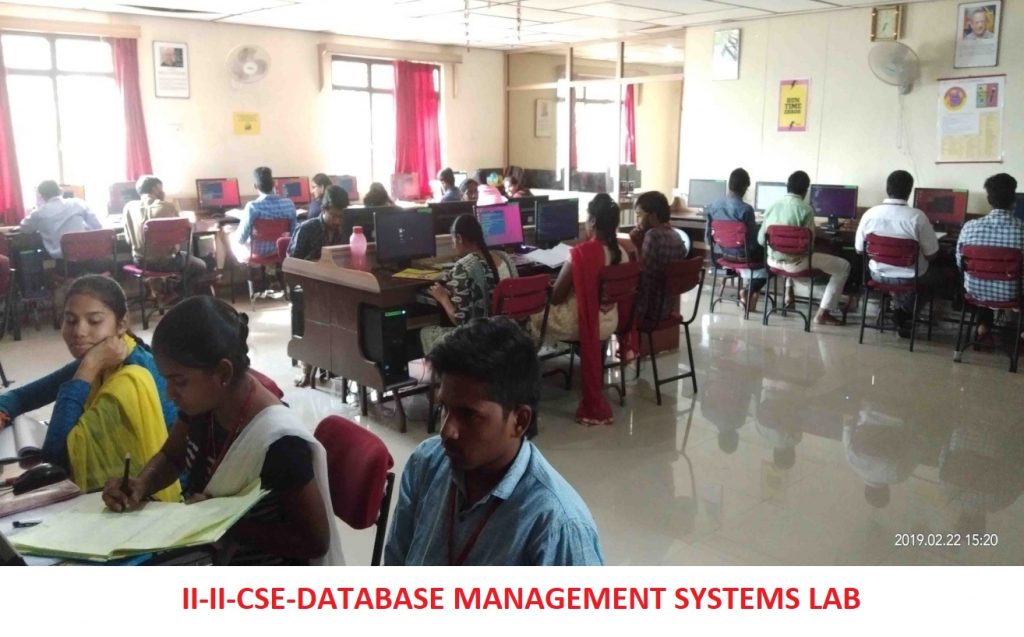 The objective of Database Management Systems lab is to develop the ability to design, implement and manipulate databases as well as to build Database management systems. In the lab, students practice DDL and DML commands, triggers, procedures, cursors using Oracle and MYSQL software.
HARDWARE:
- 30 DELL-390 DESKTOPS
- 1 Dell OptiPlex 3060 Desktop
- 1 BLADE SERVER
- 1 DELTA 7 KVA UPS
SOFTWARE:
- MS OFFICE
- MYSQL
- Oracle 11 G
LIST OF EXPERIMENTS
- Concept design with E-R Model
- Relational Model
- Normalization
- Practicing DDL commands
- Practicing DML commands
- Querying (using ANY, ALL, IN, Exists, NOT EXISTS, UNION, INTERSECT, Constraints etc.)
- Queries using Aggregate functions, GROUP BY, HAVING and Creation and dropping of Views.
- Triggers (Creation of insert trigger, delete trigger, update trigger)
- Procedures
- Usage of Cursors
II YEAR I SEMESTER – IT Essentials
 The objective of IT Essentials Lab is to impart basic computer usage and maintenance skills and to introduce the students to a suite of productivity tools that will aid the students in their day to day activities. IT workshop works in a learning-by-doing mode. It concentrates more on hands-on experience for the participants rather theoretical classes. It enables the participant to make the best use of Microsoft Office Suite in their day-to-day requirements and make use of it to improve the standards in the educational environment. The IT Workshop prepares the student to have a hands-on experience in maintaining and troubleshooting a PC by themselves.
HARDWARE:
- 31 HCL Desktops
- 5 Dell Optiplex 3060 Desktops
- 1 BLADE SERVER
- 1 APC 5KVA UPS
SOFTWARE:
- MS OFFICE
- Latex
LIST OF EXPERIMENTS
PC Hardware
Task 1: Identify the peripherals of a computer, components in a CPU and its functions. Draw the block diagram of the CPU along with the configuration of each peripheral and submit to your instructor.
Task 2: Every student should disassemble and assemble the PC back to working condition. Lab instructors should verify the work and follow it up with a Viva. Also students need to go through the video which shows the process of assembling a PC. A video would be given as part of the course content.
Task 3: Every student should individually install MS windows on the personal computer. Lab instructor should verify the installation and follow it up with a Viva.
Task 4: Every student should install Linux on the computer. This computer should have windows installed. The system should be configured as dual boot with both windows and Linux. Lab instructors should verify the installation and follow it up with a Viva
Task 5: Hardware Troubleshooting: Students have to be given a PC which does not boot due to improper assembly or defective peripherals. They should identify the problem and fix it to get the computer back to working condition. The work done should be verified by the instructor and followed up with a Viva.
Task 6: Software Troubleshooting: Students have to be given a malfunctioning CPU due to system software problems. They should identify the problem and fix it to get the computer back to working condition. The work done should be verified by the instructor and followed up with a Viva.
Internet & World Wide Web
Task1: Orientation & Connectivity Boot Camp: Students should get connected to their Local Area Network and access the Internet. In the process they configure the TCP/IP setting. Finally students should demonstrate, to the instructor, how to access the websites and email. If there is no internet connectivity preparations need to be made by the instructors to simulate the WWW on the LAN.
Task 2: Web Browsers, Surfing the Web: Students customize their web browsers with the LAN proxy settings, bookmarks, search toolbars and pop up blockers. Also, plug-ins like Macromedia Flash and JRE for applets should be configured.
Task 3: Search Engines & Netiquette: Students should know what search engines are and how to use the search engines. A few topics would be given to the students for which they need to search on Google. This should be demonstrated to the instructors by the student.
Task 4: Cyber Hygiene: Students would be exposed to the various threats on the internet and would be asked to configure their computer to be safe on the internet. They need to first install antivirus software, configure their personal firewall and windows update on their computer. Then they need to customize their browsers to block pop ups, block active x downloads to avoid viruses and/or worms.
LaTeX and WORD
Task 1: Word Orientation: The mentor needs to give an overview of LaTeX and Microsoft (MS) office 2007/ equivalent (FOSS) tool word: Importance of LaTeX and MS office 2007/ equivalent (FOSS) tool Word as word Processors, Details of the four tasks and features that would be covered in each, Using LaTeX and word – Accessing, overview of toolbars, saving files, Using help and resources, rulers, format painter in word.
Task 2: Using LaTeX and Word to create project certificate. Features to be covered:- Formatting Fonts in word, Drop Cap in word, Applying Text effects, Using Character Spacing, Borders and Colors, Inserting Header and Footer, Using Date and Time option in both LaTeX and Word.
Task 3: Creating project abstract Features to be covered:-Formatting Styles, Inserting table, Bullets and Numbering, Changing Text Direction, Cell alignment, Footnote, Hyperlink, Symbols, Spell Check, Track Changes.
Task 4 : Creating a Newsletter : Features to be covered:- Table of Content, Newspaper columns, Images from files and clipart, Drawing toolbar and Word Art, Formatting Images, Textboxes, Paragraphs and Mail Merge in word.
Excel
Excel Orientation: The mentor needs to tell the importance of MS office 2007/ equivalent (FOSS) tool Excel as a Spreadsheet tool, give the details of the four tasks and features that would be covered in each. Using Excel – Accessing, overview of toolbars, saving excel files, Using help and resources.
Task 1: Creating a Scheduler – Features to be covered: Gridlines, Format Cells, Summation, auto fill, Formatting Text
Task 2 : Calculating GPA – .Features to be covered:- Cell Referencing, Formulae in excel – average, std.deviation, Charts, Renaming and Inserting worksheets, Hyper linking, Count function, LOOKUP/VLOOKUP
Task 3: Performance Analysis – Features to be covered:- Split cells, freeze panes, group and outline, Sorting, Boolean and logical operators, Conditional formatting
LaTeX and MS/equivalent (FOSS) tool Power Point
Task 1: Students will be working on basic power point utilities and tools which help them create basic power point presentation. Topic covered during this week includes: – PPT Orientation, Slide Layouts, Inserting Text, Word Art, Formatting Text, Bullets and Numbering, Auto Shapes, Lines and Arrows in both LaTeX and PowerPoint. Students will be given model power point presentation which needs to be replicated (exactly how it’s asked).
Task 2: Second week helps students in making their presentations interactive. Topic covered during this week includes: Hyperlinks, Inserting –Images, Clip Art, Audio, Video, Objects, Tables and Charts.
Task 3: Concentrating on the in and out of Microsoft power point and presentations in LaTeX. Helps them learn best practices in designing and preparing power point presentation. Topic covered during this week includes: – Master Layouts (slide, template, and notes), Types of views (basic, presentation, slide slotter, notes etc), and Inserting – Background, textures, Design Templates, Hidden slides.
II YEAR II SEMESTER – OPERATING SYSTEMS LAB
 The lab is spread over an area of 77.4 sqm and is well equipped with 35 desktops. It is used by II year Second Semester B.TECH students to practice Operating Systems Lab.
The Operating Systems lab complements the Operating Systems Course. The goal of this lab is to make the students understand the principles in the design and implementation of operating systems software. In this lab, students implement the concepts of operating systems such as system calls, CPU scheduling, process management, memory management, Inter Process Communication and deadlock handling using C language in Linux environment.
HARDWARE:
- 30 HP PRO 330 MT Desktops
- 1 HP 280 G3 Desktop
- 4 Dell Optiplex 3060 Desktop
- 1 DELTA 6 KVA UPS
- EPSON Projector
SOFTWARE:
- TURBO C
- MS-OFFICE 2007
LIST OF EXPERIMENTS
- Write C programs to simulate the following CPU Scheduling algorithms a) FCFS b) SJF c) Round Robin d) priority
- Write programs using the I/O system calls of UNIX/LINUX operating system (open, read, write, close, fcntl, seek, stat, opendir, readdir)
- Write a C program to simulate Bankers Algorithm for Deadlock Avoidance and Prevention.
- Write a C program to implement the Producer – Consumer problem using semaphores using UNIX/LINUX system calls.
- Write C programs to illustrate the following IPC mechanisms a) Pipes b) FIFOs c) Message Queues d) Shared Memory
- Write C programs to simulate the following memory management techniques a) Paging b) Segmentation
II YEAR I SEMESTER – DATA STRUCTURES USING C LAB
The objective of Data Structures Using C Lab is to develop the generic skills required to design and implement Abstract Data Types (ADTs) and non-linear data structures for a broad range of computing problems. In this lab, students design and evaluate ADTs, develop programs for data structures such as stacks, queues, and linked lists, work with non-linear data structures such as trees and graphs, and implement searching and sorting algorithms using the C programming language.
Hardware
- 30 WIPRO Desktops
- 3 Dell OptiPlex 3060 Desktops
- 1 DELTA 11 KVA UPS
Software
- g++ Compiler
- MS Office
List of Experiments
-
Write a program that uses functions to perform the following operations on a singly linked list:
- Creation
- Insertion
- Deletion
- Traversal
-
Write a program that uses functions to perform the following operations on a doubly linked list:
- Creation
- Insertion
- Deletion
- Traversal
-
Write a program that uses functions to perform the following operations on a circular linked list:
- Creation
- Insertion
- Deletion
- Traversal
-
Write a program that implements Stack and its operations using:
- Arrays
- Pointers
-
Write a program that implements Queue and its operations using:
- Arrays
- Pointers
-
Write a program that implements the following sorting methods to sort a given list of integers in ascending order:
- Bubble Sort
- Selection Sort
- Insertion Sort
-
Write a program that uses both recursive and non-recursive functions to perform the following searching operations for a key value in a given list of integers:
- Linear Search
- Binary Search
- Write a program to implement the tree traversal methods.
- Write a program to implement the graph traversal methods.
III YEAR I SEMESTER – DESIGN AND ANALYSIS OF ALGORITHMS LAB
 The objective of the Design and Analysis of Algorithms Lab is to enable students to design algorithms for real-world problems and analyze their running time. In this lab, students use Java programming language to implement algorithmic techniques such as Divide and Conquer, Greedy Method, Graph Traversals, Dynamic Programming, and Backtracking.
Hardware
- 29 Dell OptiPlex 390 Desktops
- 1 Lenovo Desktop
- 3 Dell OptiPlex 3060 Desktops
- 11 KVA UPS
- 1 Hitachi Projector
Software
- JDK 1.8
- Eclipse
- NetBeans
List of Experiments
- Write a Java program to implement Quick Sort algorithm for sorting a list of integers in ascending order.
- Write a Java program to implement Merge Sort algorithm for sorting a list of integers in ascending order.
- Graph Traversal Algorithms:
- Write a Java program to implement the Depth First Search (DFS) algorithm for a graph.
- Write a Java program to implement the Breadth First Search (BFS) algorithm for a graph.
- Write a Java program to implement the Backtracking algorithm for the N-Queens problem.
- Write a Java program to implement the Backtracking algorithm for the Sum of Subsets problem.
- Write a Java program to implement the Backtracking algorithm for the Hamiltonian Circuits problem.
- Write a Java program to implement the Greedy algorithm for Job Sequencing with Deadlines.
- Write a Java program to implement Dijkstra’s algorithm for the Single Source Shortest Path problem.
- Write a Java program that implements Prim’s algorithm to generate a Minimum Cost Spanning Tree.
- Write a Java program that implements Kruskal’s algorithm to generate a Minimum Cost Spanning Tree.
- Write a Java program to implement Floyd’s algorithm for the All-Pairs Shortest Path problem.
- Write a Java program to implement the Dynamic Programming algorithm for the 0/1 Knapsack problem.
- Write a Java program to implement the Dynamic Programming algorithm for the Optimal Binary Search Tree problem.
III YEAR I SEMESTER – COMPUTER NETWORKS LAB
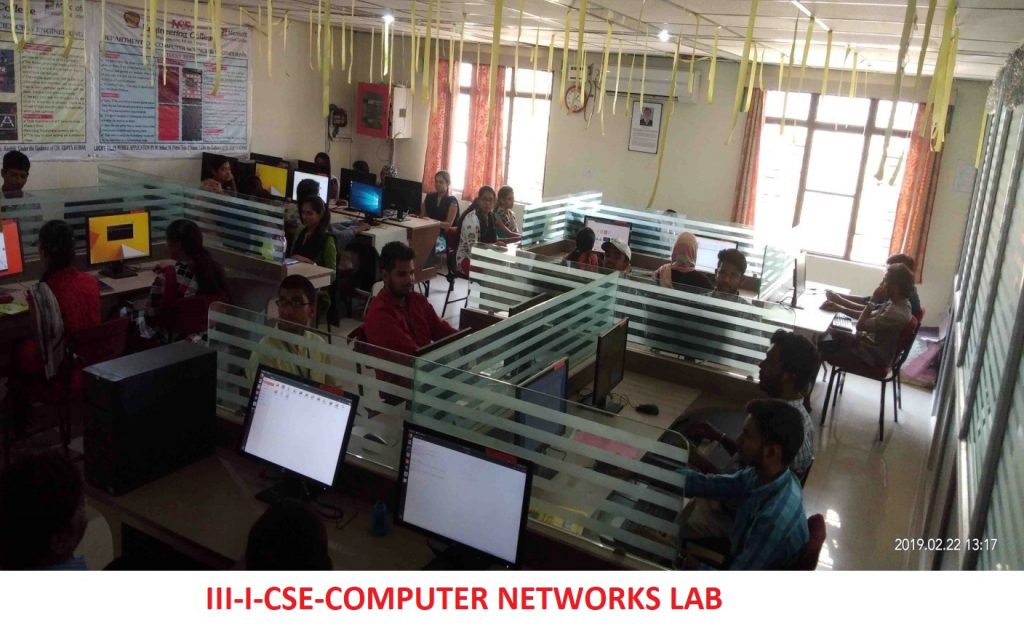 The objective of Computer Networks lab is to learn basic concepts of computer networking and acquire practical working of protocols with the emphasis on TCP/IP. In the lab, students program in C and JAVA language to implement error detection and error correction codes, congestion control algorithms, routing algorithms. This lab makes students familiar to the working environment of WireShark, a network protocol analyzer and NS2 Simulator.
HARDWARE:
- 30 HP 280 G3 DESKTOP
- 3 Dell OptiPlex 3060 Desktop
- 6 KVA DELTA UPS
SOFTWARE:
- Turbo C
- JDK 1.8
- Eclipse
- NetBeans
- NS2
- Wireshark
LIST OF EXPERIMENTS
- Implement the data link layer framing methods such as character, character-stuffing and bit stuffing.
- Write a program to compute CRC code for the polynomials CRC-12, CRC-16 and CRC CCIP
- Develop a simple data link layer that performs the flow control using the sliding window protocol, and loss recovery using the Go-Back-N mechanism.
- Implement Dijkstra’s algorithm to compute the shortest path through a network.
- Take an example subnet of hosts and obtain a broadcast tree for the subnet.
- Implement distance vector routing algorithm for obtaining routing tables at each node.
- Implement data encryption and data decryption.
- Write a program for congestion control using Leaky bucket algorithm.
- Write a program for frame sorting technique used in buffers.
Wireshark
- Packet Capture Using Wire shark
- Starting Wire shark
- Viewing Captured Traffic
- Analysis and Statistics & Filters.
- How to run Nmap scan
- Operating System Detection using Nmap
- Do the following using NS2 Simulator
- NS2 Simulator-Introduction
- Simulate to Find the Number of Packets Dropped
- Simulate to Find the Number of Packets Dropped by TCP/UDP
- Simulate to Find the Number of Packets Dropped due to Congestion
- Simulate to Compare Data Rate& Throughput.
- Simulate to Plot Congestion for Different Source/Destination
- Simulate to Determine the Performance with respect to Transmission of Packets
III YEAR I SEMESTER – SOFTWARE ENGINEERING LAB
 The objective of the Software Engineering Lab is to help students acquire software development skills through the various phases of the Software Development Life Cycle (SDLC). Students learn to ensure software quality through protocol-based software development environments, generate test cases for software testing, and work with software development models using rational methods. IBM Rational Rose Enterprise Edition and other IBM Rational tools are used to support these objectives.
Hardware
- 30 HP 280 G3 Desktops
- 3 Dell OptiPlex 3060 Desktops
- 1 WIPRO Desktop
- 6 KVA UPS
- 1 EPSON Projector
Software
- JDK 1.8
- MS Office 2007
- IBM Rational Seed Program (Licensed)
- IBM Rational Software Architect (Licensed)
- IBM Rational Functional Tester (Licensed)
- IBM Rational Quality Manager
List of Experiments
Perform the following eight exercises for any two projects selected from the sample projects list or any other suitable project.
- Development of Problem Statement.
- Preparation of:
- Software Requirement Specification (SRS) Document
- Design Documents
- Testing Phase Related Documents
- Preparation of:
- Software Configuration Management Documents
- Risk Management Documents
- Study and usage of any Design Phase CASE Tool.
- Perform software design using any Design Phase CASE Tool.
- Develop test cases for Unit Testing and Integration Testing.
- Develop test cases for various White Box Testing techniques.
- Develop test cases for various Black Box Testing techniques.
Sample Projects
- Passport Automation System
- Book Bank
- Online Exam Registration System
- Stock Maintenance System
- Online Course Reservation System
- E-Ticketing System
- Software Personnel Management System
- Credit Card Processing System
- E-Book Management System
- Recruitment System
III YEAR I SEMESTER – R PROGRAMMING LAB
The objective of the R Programming Lab is to introduce students to the R programming language and R Studio. In this lab, students practice basic R programs, import datasets, review and summarize data, explore datasets to create testable hypotheses, and identify appropriate statistical tests for data analysis.
Hardware
- 29 Dell OptiPlex 390 Desktops
- 1 Lenovo Desktop
- 3 Dell OptiPlex 3060 Desktops
- 11 KVA UPS
- 1 Hitachi Projector
Software
- R
- R Studio
List of Experiments
- Write an R Program to print “Hello World”.
- Write an R Program to take input from the user.
- Write an R Program to demonstrate working with:
- Arithmetic Operators
- Relational Operators
- Logical Operators
- Assignment Operators
- Write an R Program to check whether a number is Odd or Even.
- Write an R Program to check whether a given number is Prime.
- Write an R Program to find the Factorial of a number.
- Write an R Program to find the Factors of a number.
- Write an R Program to generate the Fibonacci sequence using a Recursive Function.
- Write an R Program to create a Simple Calculator.
- Write an R Program to find the LCM (Least Common Multiple) of two numbers.
- Write an R Program to create a Vector and access elements in the Vector.
- Write an R Program to create a Matrix and access rows and columns using:
colnames()rownames()
- Write an R Program to create a Matrix using
cbind()andrbind(). - Write an R Program to create a Matrix from a Vector using
dim(). - Write an R Program to create a List and modify its components.
- Write an R Program to create a Data Frame.
- Write an R Program to access a Data Frame like a List.
- Write an R Program to access a Data Frame like a Matrix.
- Write an R Program to create a Factor.
- Write an R Program to access and modify components of a Factor.
- Write an R Program to create an S3 Class and S3 Objects.
- Write an R Program to write your own Generic Function in an S3 Class.
- Write an R Program to create an S4 Class and S4 Objects.
- Write an R Program to write your own Generic Function in an S4 Class.
- Write an R Program to create a Reference Class and modify its Methods.
III YEAR I SEMESTER – WEB TECHNOLOGIES LAB
 The Web Technologies Lab is intended to help students develop web applications using the language of the web, namely Hyper Text Markup Language (HTML), Cascading Style Sheets (CSS), and JavaScript. Students learn to create and control dynamic web pages, understand the differences between client-side and server-side scripting languages, and develop interactive web applications using PHP, Servlets, and Java Server Pages (JSP).
Hardware
- 30 HP 280 G3 Desktops
- 3 Dell OptiPlex 3060 Desktops
- 11 KVA DELTA UPS
Software
- JDK 1.8
- Apache 2
- Apache Tomcat 7
- PHP
- Oracle 11G
- MySQL
List of Experiments
- Write a PHP script to print prime numbers between 1 and 50.
- Write a PHP script to:
- Find the length of a string.
- Count the number of words in a string.
- Reverse a string.
- Search for a specific string.
- Write a PHP script to merge two arrays and sort them as numbers in descending order.
- Write a PHP script that reads data from one file and writes it into another file.
- Develop static web pages (using only HTML) for an Online Book Store. The pages should resemble an online shopping website such as Amazon. The website should consist of the following pages:
- Home Page
- Registration and User Login
- User Profile Page
- Books Catalog
- Shopping Cart
- Payment by Credit Card
- Order Confirmation
- Validate the Registration, User Login, User Profile, and Payment by Credit Card pages using JavaScript.
- Create and save an XML document on the server containing information for 10 users.
Write a program that takes a User ID as input and returns the corresponding user details from the XML document. - Install the TOMCAT Web Server. Convert the static web pages developed earlier into dynamic web pages using Servlets and Cookies.Hint:
- User information (User ID, Password, Credit Card Number) should be stored in
web.xml. - Each user should have a separate Shopping Cart.
- User information (User ID, Password, Credit Card Number) should be stored in
- Redo the previous task using JSP by converting the static web pages into dynamic web pages.Create a database containing:
- User Information
- Books Information
The Books Catalog should be dynamically loaded from the database.
Follow the MVC (Model-View-Controller) architecture while developing the website.
III YEAR II SEMESTER – NETWROK PROGRAMMING LAB
 The objective of Network Programming Lab is to introduce Network related commands and configuration files in Linux Operating System. In the lab, students practice network programming using Linux system calls and analyze network traffic using network monitoring tools like WireShark.
HARDWARE:
- 23 DELL OPTILEX 380 Desktops
- 1 LENOVO 500 Desktop
- 9 Dell OptiPlex 3060 Desktops
- 1 DELTA 7KVA UPS
SOFTWARE:
- g++ compiler
- NS2 Simulator
- WireShark
LIST OF EXPERIMENTS
- Implement programs for Inter Process Communication using PIPE, Message Queue and Shared Memory.
- Write a program to create an integer variable using shared memory concept and increment the variable simultaneously by two processes. Use semaphores to avoid race conditions.
- Design TCP iterative Client and server application to reverse the given input sentence
- Design TCP iterative Client and server application to reverse the given input sentence
- Design TCP client and server application to transfer file
- Design a TCP concurrent server to convert a given text into upper case using multiplexing system call “select”
- Design a TCP concurrent server to echo given set of sentences using poll functions
- Design UDP Client and server application to reverse the given input sentence
- Design UDP Client server to transfer a file
- Design using poll client server application to multiplex TCP and UDP requests for converting a given text into upper case.
- Design a RPC application to add and subtract a given pair of integers
SCRIPTING LANGUAGES LAB
The objective of Scripting Languages lab is to make the students understand the difference between programming language and scripting language. In the lab, students practice simple programs using scripting languages like Ruby, Perl, and TCL. Students also develop web based projects using Ruby, Perl and TCL.
HARDWARE:
- 23 DELL OPTILEX 380 Desktops
- 1 LENOVO 500 Desktop
- 9 Dell Optiplex 3060 Desktops
- 1 DELTA 7KVA UPS
SOFTWARE:
- g++ compiler
- Python3 (Open Source)
- Ruby
LIST OF EXPERIMENTS
- a) Write a Perl script to substitute a word, with another word in a string. b) Write a Perl script to validate IP address and email address.
- Write a Ruby script to create a new string which is n copies of a given string where n is a nonnegative integer
- Write a Ruby script which accept the radius of a circle from the user and compute the parameter and area.
- Write a Ruby script which accept the user’s first and last name and print them in reverse order with a space between them
- Write a Ruby script to accept a filename from the user print the extension of that
- Write a Ruby script to find the greatest of three numbers
- Write a Ruby script to print odd numbers from 10 to 1
- Write a Ruby script to check two integers and return true if one of them is 20 otherwise return their sum
- Write a Ruby script to check two temperatures and return true if one is less than 0 and the other is greater than 100
- Write a Ruby script to print the elements of a given array
- Write a Ruby program to retrieve the total marks where subject name and marks of a student stored in a hash
- Write a TCL script to find the factorial of a number
- Write a TCL script that multiplies the numbers from 1 to 10
- Write a TCL script for Sorting a list using a comparison function
- Write a TCL script to (i)create a list (ii )append elements to the list (iii)Traverse the list (iv)Concatenate the list
- Write a TCL script to comparing the file modified times.
- Write a TCL script to Copy a file and translate to native format.
- a)Write a Perl script to find the largest number among three numbers. b) Write a Perl script to print the multiplication tables from 1-10 using subroutines.
- Write a Perl program to implement the following list of manipulating functions a)Shift b)Unshift c) Push
- Write a Perl script to print the file in reverse order using command line arguments
III YEAR II SEMESTER – MACHINE LEARNING LAB
 The objective of the Machine Learning Lab is to help students understand the implementation procedures of machine learning algorithms. In this lab, students design Python programs for machine learning algorithms and apply them to solve real-world problems.
Hardware
- 30 HP 280 G3 Desktops
- 3 Dell OptiPlex 3060 Desktops
- 11 KVA DELTA UPS
Software
- Oracle 11G
- MySQL
- MS Office 2007
- Python
- Anaconda
List of Experiments
- The probability that it is Friday and that a student is absent is 3%.
Since there are 5 school days in a week, the probability that it is Friday is 20%.
Find the probability that a student is absent given that today is Friday.
Apply Bayes’ Rule in Python to obtain the result.Expected Answer: 15%
- Extract data from a database using Python.
- Implement K-Nearest Neighbours (KNN) classification using Python.
- Given the following dataset, predict a classification for a case where
VAR1 = 0.906 and VAR2 = 0.606 using
K-Means Clustering with 3 means (3 centroids).
Dataset
| VAR1 | VAR2 | CLASS |
|---|---|---|
| 1.713 | 1.586 | 0 |
| 0.180 | 1.786 | 1 |
| 0.353 | 1.240 | 1 |
| 0.940 | 1.566 | 0 |
| 1.486 | 0.759 | 1 |
| 1.266 | 1.106 | 0 |
| 1.540 | 0.419 | 1 |
| 0.459 | 1.799 | 1 |
| 0.773 | 0.186 | 1 |
Probability Dataset
The following training examples map descriptions of individuals onto
High, Medium and Low Credit Risk categories.
- medium skiing design single twenties no → high-risk
- high golf trading married forties yes → low-risk
- low speedway transport married thirties yes → med-risk
- medium football banking single thirties yes → low-risk
- high flying media married fifties yes → high-risk
- low football security single twenties no → med-risk
- medium golf media single thirties yes → med-risk
- medium golf transport married forties yes → low-risk
- high skiing banking single thirties yes → high-risk
- low golf unemployed married forties yes → high-risk
Input attributes (from left to right):
- Income
- Recreation
- Job
- Status
- Age Group
- Home Owner
Find:
- The unconditional probability of golf.
- The conditional probability of single given med-risk.
III YEAR II SEMESTER – COMPILER DESIGN LAB
Compiler Design Laboratory
The objective of the Compiler Design Lab is to understand and implement the principles, techniques, and tools used in the compiler construction process. This enables students to work in the development phase of new computer languages in industry.
Hardware
- 30 WIPRO Desktops
- 3 Dell OptiPlex 3060 Desktops
- 1 DELTA 11 KVA UPS
Software
- g++ Compiler
- YACC Compiler
- MS Office
List of Experiments
- Write a LEX program to scan reserved words and identifiers of C language.
- Implement Predictive Parsing Algorithm.
- Write a C program to generate Three Address Code.
- Implement SLR(1) Parsing Algorithm.
- Design an LALR Bottom-Up Parser for the following language:
<program> ::= <block> <block> ::= { <variabledefinition> <slist> } | { <slist> } <variabledefinition> ::= int <vardeflist> ; <vardeflist> ::= <vardec> | <vardec> , <vardeflist> <vardec> ::= <identifier> | <identifier> [ <constant> ] <slist> ::= <statement> | <statement> ; <slist> <statement> ::= <assignment> | <ifstatement> | <whilestatement> | <block> | <printstatement> | <empty> <assignment> ::= <identifier> = <expression> | <identifier> [ <expression> ] = <expression> <ifstatement> ::= if <bexpression> then <slist> else <slist> endif | if <bexpression> then <slist> endif <whilestatement> ::= while <bexpression> do <slist> enddo <printstatement> ::= print ( <expression> ) <expression> ::= <expression> <addingop> <term> | <term> | <addingop> <term> <bexpression> ::= <expression> <relop> <expression> <relop> ::= < | <= | == | >= | > | != <addingop> ::= + | - <term> ::= <term> <multop> <factor> | <factor> <multop> ::= * | / <factor> ::= <constant> | <identifier> | <identifier> [ <expression> ] | ( <expression> ) <constant> ::= <digit> | <digit> <constant> <identifier> ::= <identifier> <letterordigit> | <letter> <letterordigit> ::= <letter> | <digit> <letter> ::= a|b|c|d|e|f|g|h|i|j|k|l|m|n|o|p|q|r|s|t|u|v|w|x|y|z <digit> ::= 0|1|2|3|4|5|6|7|8|9 <empty> ::= ε - Comments (zero or more characters enclosed between standard C/Java-style
comment brackets/* ... */) can be inserted. - The language supports one-dimensional arrays.
Example:
int a[3]declares an array of three elements:
a[0],a[1], anda[2]. - Consider proper scoping of variable names while designing the parser.
- Sample Program:
{
    int a[3], t1, t2;

    t1 = 2;

    a[0] = 1;
    a[1] = 2;
    a[t1] = 3;

    t2 = -(a[2] + t1 * 6) / (a[2] - t1);

    if t2 > 5 then
        print(t2);
    else
    {
        int t3;

        t3 = 99;
        t2 = -25;

        print(-t1 + t2 * t3);

        /* this is a comment
           on 2 lines */
    }
    endif
}
III YEAR II SEMESTER – SOFTWARE TESTING METHODOLOGIES LAB
The objective of Software Testing Methodologies Lab is to provide knowledge of Software Testing Methods and to encourage the students to develop skills in software test automation and management using latest tools like Selenium.
HARDWARE:
- 23 DELL OPTILEX 380 Desktops
- 1 LENOVO 500 Desktop
- 9 Dell Optiplex 3060 Desktops
- 1 DELTA 7KVA UPS
SOFTWARE:
- Selenium
LIST OF EXPERIMENTS
- Recording in context sensitive mode and analog mode
- GUI checkpoint for single property
- GUI checkpoint for single object/window
- GUI checkpoint for multiple objects
- a) Bitmap checkpoint for object/window b) Bitmap checkpoint for screen area
- Database checkpoint for Default check
- Database checkpoint for custom check
- Database checkpoint for runtime record check
- a) Data driven test for dynamic test data submission b) Data driven test through flat files c) Data driven test through front grids d) Data driven test through excel test
- Batch testing without parameter passing and with parameter passing
- Data driven batch
- Silent mode test execution without any interruption.
- Test case for calculator in windows application
IV YEAR I SEMESTER – ANDROID APPLICATION DEVELOPMENT LAB
 The objective of the lab is to make students learn the fundamentals of developing Android Applications, from project creation to installation on a physical device. In this lab, students make use of Android Studio to develop Android applications. Students develop user interface applications and URL-related Android applications.
Hardware
- 30 HP 280 G3 Desktops
- 3 Dell OptiPlex 3060 Desktops
- 1 WIPRO Desktop
- 6 KVA UPS
- 1 EPSON Projector
Software
- JDK 1.8
- Android Studio
- MS Office 2007
List of Experiments
- Hello Android Application
- Create an Android application that displays Hello + Name of the User and run it on an emulator.
- Create an application that takes the name from a text box and displays a hello message along with the entered name when the user clicks the OK button.
- User Information Form
Create a screen that contains:- User Name
- Password
- Address
- Gender (Radio Buttons – Male/Female)
- Age (Numeric)
- Date of Birth (Date Picker)
- State (Spinner)
- Submit Button
On clicking the Submit button, display all entered details below the Submit button using:
- Linear Layout and Relative Layout
- Grid Layout or Table Layout
- Candidate Details using Fragments
Develop an application that displays names in a list. On selecting a name, display the candidate details on the next screen with a Back button.If the screen is rotated to landscape mode (width greater than height), display:- List in the left fragment
- Details in the right fragment
Use Fragment Transactions and Rotation Event Listener.
- Intent-Based Application
Develop an application that uses a menu with the following options:- Dial a phone number
- Open a website
- Send an SMS
Use Android Intents to invoke the corresponding actions.
- Notification Application
Develop an application that inserts notifications into the Notification Area. Whenever a notification is inserted, display a Toast message with the notification details. - Login Verification using Text File
Create an application that stores usernames and passwords in a text file (tab-separated fields and one record per line).When the user enters login credentials:- Verify the credentials against the file data.
- If matched, display a dialog showing Login Successful.
- Otherwise, display Login Failed.
- User Registration using Database
Create a user registration application that stores user details in a database table. - Login Verification using Database
Create a database and a user table containing login names and passwords.Requirements:- Insert some usernames and passwords initially.
- Verify login credentials entered by the user against the database.
- Display an appropriate success or failure dialog.
IV YEAR I SEMESTER – CRYPTOGRAPHY AND NETWORK SECURITY LAB
 The objective of the lab is to provide practical exposure to students on cryptography. In this lab, students implement cryptographic algorithms using C and Java programming languages. The lab provides a practical approach to encryption techniques, message authentication codes, symmetric key algorithms, and asymmetric key algorithms used in cryptography.
Hardware
- 30 HP 280 G3 Desktops
- 3 Dell OptiPlex 3060 Desktops
- 6 KVA Delta UPS
Software
- Turbo C
- JDK 1.8
- Eclipse
- NetBeans
List of Experiments
- Write a C program that contains a string (char pointer) with the value
"Hello World". The program should XOR each character in the
string with 0 and display the result. - Write a C program that contains a string (char pointer) with the value
"Hello World". The program should perform AND and XOR operations
on each character using the value 127 and display the result. - Write a Java program to perform encryption and decryption using the following algorithms:
- Caesar Cipher
- Substitution Cipher
- Hill Cipher
- Write a C/Java program to implement the DES (Data Encryption Standard) algorithm.
- Write a C/Java program to implement the Blowfish algorithm.
- Write a C/Java program to implement the Rijndael (AES) algorithm.
- Implement the RC4 algorithm in Java. Using Java Cryptography, encrypt the text
"Hello World"using the Blowfish algorithm and create your own key
using the Java Key Tool. - Write a Java program to implement the RSA algorithm.
- Implement the Diffie-Hellman Key Exchange mechanism using HTML and JavaScript.
- Calculate the message digest of a text using the SHA-1 algorithm in Java.
- Calculate the message digest of a text using the MD5 algorithm in Java.
IV YEAR I SEMESTER – DATA MINING LAB
 The objective of Data Mining Lab is to give practical exposure to students on data mining techniques using real-world datasets. In this lab, students visualize and analyze dataset attributes, apply data preprocessing techniques, implement data mining algorithms related to association mining, classification, and clustering, and evaluate algorithm performance using WEKA and other data mining tools.
Hardware
- 30 Dell-390 Desktops
- 1 Dell OptiPlex 3060 Desktop
- 1 Blade Server
- 1 Delta 7 KVA UPS
Software
- Pentaho Data Integration Tool
- R
- R Studio
- WEKA
- MS Office
- MySQL
- Oracle 11g
List of Experiments
Task 1: Credit Risk Assessment
Description: The business of banks is making loans. Assessing the credit
worthiness of an applicant is of crucial importance. Develop a system to help a loan officer
decide whether the credit of a customer is good or bad.
A bank’s loan policy must balance two opposing factors:
- The bank wants to issue as many loans as possible because loan interest generates profit.
- The bank must avoid issuing too many bad loans, which can lead to financial losses.
Therefore, the loan policy should be neither too strict nor too lenient.
To complete this assignment, acquire knowledge about credit assessment using one or more of the following approaches:
- Knowledge Engineering:
Interview a loan officer and represent their knowledge using production rules. - Training Manuals and Textbooks:
Study loan officer manuals or finance textbooks and convert the knowledge into production rules. - Common Sense Approach:
Assume the role of a loan officer and formulate reasonable rules for judging creditworthiness. - Case Histories:
Analyze historical loan approval and rejection cases handled by experienced loan officers.
The German Credit Data
Actual historical credit datasets are often difficult to obtain because of confidentiality
restrictions. This assignment uses the German Credit Dataset, which contains 1000 real-world
credit cases collected in Germany.
An Excel spreadsheet version of the dataset may be used for analysis and classification.
Notes on the German Credit Dataset
- DM (Deutsche Mark) was the German currency and was worth approximately
90 Canadian cents. - Telephone charges in Germany were relatively high; therefore fewer people owned telephones.
- Germany has a large immigrant population, particularly from Turkey, and obtaining German
citizenship is traditionally difficult for non-native residents. - The dataset contains 20 attributes used to evaluate loan applicants.
The objective is to classify each applicant into one of the following categories:- Good Credit Risk
- Bad Credit Risk
IV YEAR I SEMESTER – PYTHON PROGRAMMING LAB
 The objective of Python Programming Lab is to introduce core programming basics and program design with functions, Object-Oriented Programming, in-depth data and information processing techniques, and high-performance programs designed to strengthen practical expertise.
Hardware
- 30 Dell OptiPlex 390 Desktops
- 2 Dell OptiPlex 3060 Desktops
- 6 KVA UPS
Software
- Python 3 (Open Source)
- Python IDE
- Anaconda
- Jupyter Notebook
- MySQL
- MS Office
List of Experiments
- Write a program to demonstrate different number data types in Python.
- Write a program to perform different arithmetic operations on numbers in Python.
- Write a program to create, concatenate, and print a string and access sub-strings from a given string.
- Write a Python script to print the current date in the following format:
Sun May 29 02:26:23 IST 2017 - Write a program to create, append, and remove lists in Python.
- Write a program to demonstrate working with tuples in Python.
- Write a program to demonstrate working with dictionaries in Python.
- Write a Python program to find the largest of three numbers.
- Write a Python program to convert temperatures to and from Celsius and Fahrenheit.
c / 5 = (f - 32) / 9 - Write a Python program to construct the following pattern using a nested for loop:
*
* *
* * *
* * * *
* * * * *
* * * * * *
- Write a Python script that prints prime numbers less than 20.
- Write a Python program to find the factorial of a number using recursion.
- Write a program that accepts the lengths of three sides of a triangle as inputs.
- The program output should indicate whether or not the triangle is a right triangle
(Recall from the Pythagorean Theorem that in a right triangle, the square of one side
equals the sum of the squares of the other two sides). - Write a Python program to define a module to find Fibonacci numbers and import the
module into another program. - Write a Python program to define a module and import a specific function in that
module into another program. - Write a script named
copyfile.py. The script should prompt the user
for the names of two text files. The contents of the first file should be copied
and written to the second file. - Write a program that inputs a text file. The program should print all of the
unique words in the file in alphabetical order. - Write a Python class to convert an integer to a Roman numeral.
- Write a Python class to implement
pow(x, n). - Write a Python class to reverse a string word by word.
Advisory Board Members
| S.No | Designation Head | Name of the Person | Details of the Person |
|---|---|---|---|
| 1. | Head of the Department | Dr. Ch. Vijaya Kumar | Professor & HOD of CSE |
| 2. | Department Faculty | Dr. Khaleel Ur Rahman Khan | Professor |
| Dr. B. Ranga Swamy | Professor | ||
| Dr. V. Ravi Kumar | Professor | ||
| Mr. V. Chandrasekhar Reddy | Associate Professor | ||
| Mr. A. Ramesh | Associate Professor | ||
| 3. | Students | Ms. Navya Sai Sadu | IV CSE |
| Ms. Pannala Manasa | IV CSE | ||
| Bayya Pavan Kumar | IV CSE | ||
| Ms. Depangi Tejaswi | IV CSE | ||
| 4. | Parents | Mr. Ch. Rajaram | Asst. Manager, South Central Railway |
| Mr. Y. Ramesh | Business | ||
| 5. | Alumni | Mr. R. Krishna Arun | Network Consulting Engineer, CISCO |
| Ms. G. Naimisha | Software Engineer, Value Labs | ||
| 6. | Professional Bodies Members | Mr. Santosh Kumar Satnami | Secretary, CSI Hyderabad Chapter |
| Mohammed Jaffer Pasha | Senior Technical Trainer, TASK, Telangana | ||
| 7. | Employers | Mr. Phani Kishore | Gnana Astra Solutions Pvt. Ltd. |
| Mr. Pavan M | HR Head, TCS |
Placements Highlights – 2022 – 26

80
Campus Interviews Conducted

9
Programs Available for the Students

12 LPA
Highest Package 12 LPA in Amazon

475
Successful Campus Placements
Our Top Recruiters




Roll Of Honour

Gatadi Unnati
H : No : 22AG1A0589
BATCH : 2022-2026

Boyapally Nagaraju
H : No : 21AG1A05D8
BATCH : 2021-2025

Suvidha Bandari
H : No : 20AG1A05G9
BATCH : 2020-2024
Tallapragada Veera Venkata Kiranmai
H : No : 19AG1A05B2
BATCH : 2019-2023

Nakkala Jyothi
H : No : 18AG1A0598
BATCH : 2018-2022

Lenkalapally Vaishnitha
H : No : 17AG1A0561
BATCH : 2017-2021

G. Naimisha
H : No : 16AG1A0520
BATCH : 2016-2020

T. Venkata Aditya
H : No : 15AG1A0532
BATCH : 2015-2019

A. Swetha
H : No : 14AG1A0505
BATCH : 2014-2018

K. Tejasri Reddy
H : No : 13AG1A0541
BATCH : 2013-2017

B. Shivani
H : No : 12AG1A05180
BATCH : 2012-2016

A. U. Sruthi
H : No : 11AG1A0503
BATCH : 2011-2015
C. Manogna
H : No : 10AG1A0523
BATCH : 2010-2014

K Anusha
H : No : 09AG1A0527
BATCH : 2009-2013

Sakilam Vidya
H : No : 08AG1A0547
BATCH : 2008-2012

P.Sri Harsha Kiran
H : No : 07AG1A0539
BATCH : 2007-2011
Syllabus
REGULATION R25 – CSE
REGULATION R22 – CSE
REGULATION R20 – CSE
Events and Activities
MOU’s
| S. No | Name of the Organization | Location | Date |
|---|---|---|---|
| 1 | Pupilfirst Private Limited | Thiruvananthapuram, KS | 17.02.2023 |
| 2 | Soham Academy of Human Excellence | Hyderabad | 23.12.2022 |
| 3 | TASK – CISCO Networking Academy | Hyderabad | 2025 |
| 4 | Chargekart – Skill Development | Hyderabad | 11.05.2023 |
| 5 | AWS Skill Builder-Service Terms | Hyderabad | 14.10.2024 |
| 6 | EduSkills Foundation | Bhubaneswar, OS | 22.07.2024 |
| 7 | Artificial Intelligence Medical & Engineering Researchers Society (Membership – ID: AIMERS-INS121) | Hyderabad | Jun 2024 |
| 8 | Brain O Vision Solutions Pvt Ltd | Hyderabad | 15.11.2019 |
| 9 | Deepsphere AI India Pvt. Ltd. | Chennai, TS | 20.08.2021 |
| 10 | ExcelR Solutions | Hyderabad | 20.03.2023 |
| 11 | Cymax Infotainment Pvt Ltd | Hyderabad | 06.09.2023 |
| 12 | TalentSprint Pvt Ltd – Skill Development | Hyderabad | 06.05.2022 |
| 13 | SmartInternz – Smartstart Program MOU | Hyderabad | 09.05.2024 |
| 14 | ICT ACADEMY-ACE HONEYWELL COE | Hyderabad | 01.08.2023 |
Placements
| S.No | Roll ⬍ | Name ⬍ | Branch ⬍ | Company ⬍ | Role ⬍ | Package ⬍ | Year ⬍ |
|---|